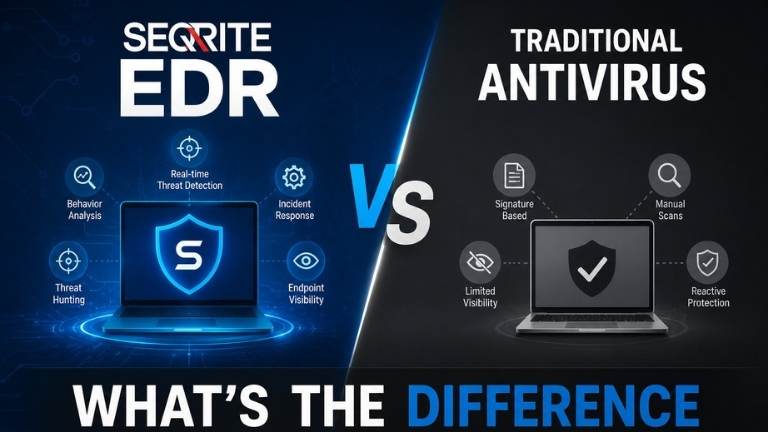
Traditional antivirus software has historically served as the initial defence against cyberattacks; however, more complex security challenges necessitate that a new and superior solution be employed. This is where Endpoint Detection & Response (EDR) solutions like Seqrite EDR come into play. So, what’s the distinction between Seqrite EDR and traditional antivirus software? And, more importantly, which is better-suited for your business?
This article will explain how Seqrite EDR differs from conventional antivirus protection and why modern businesses are looking toward EDR technologies to improve their security protection
Understanding Traditional Antivirus Software
The main use of traditional antivirus software is to find, stop, and delete all the different types of malware. To do this, traditional AV software utilizes the following:
- Signature Detection
- Database of Known Threats
- Scheduled Scans
- Real Time Monitoring
When a new file is introduced to a system, the antivirus scans it against its malware signature database. If it finds a match to the known malware signatures, the file is either quarantined or deleted.
Advantages of Traditional Antivirus Are:
- They are simple to install and manage.
- They tend to cost less for small organizations.
- They are effective against known malware.
- They provide some basic protection for endpoints.
- The Limitations of Traditional Antivirus Are:
- They are not effective against zero-day attacks.
- They do not allow for much visibility into the activities of endpoints.
- They cannot effectively detect file-less malware.
- They are primarily reactive, rather than proactive.
- They are not much help in investigating incidents.
As hackers develop new techniques to attack, traditional AVs will typically not be able to detect threats that do not match the established malware signatures.
What is Seqrite EDR?
Seqrite’s EDR (Endpoint Detection & Response) utilizes sophisticated technology to help organizations proactively monitor their endpoints for malicious activity, identify potentially harmful behavior, detect advanced cyber threats, and respond quickly to incidents.
In contrast to conventional antivirus solutions, Seqrite EDR provides organizations with an alternative to potentially dangerous files and gives them an opportunity to hunt down and remove them by utilizing behavioral and threat intelligence.
Organizations will have complete visibility over all endpoints and will be able to detect and respond quickly to any malicious activity before it causes serious damage.
Key Features of Seqrite EDR
1. Continuous Monitoring of Endpoints
Continuous endpoint monitoring is an essential component of Seqrite EDR’s capabilities. Rather than simply scanning systems on a schedule as is done with traditional security services, Seqrite EDR continuously monitors endpoint activity in real time. All activity on an endpoint is monitored, including running processes, files, users, and network connections, as well as changes to the system’s settings; this gives security teams visibility to identify suspicious activity immediately, rather than after damage has already been caused by a successful attack. Organizations have a significantly lower risk of being exposed to unknown threats when endpoints are monitored at all times.
2. Sophisticated Detection of Threats
Typical modern cyber attacks use advanced methods, making them almost impossible for traditional antivirus applications to detect. Seqrite EDR uses several advanced detection capabilities that combine behavioral analysis and machine learning, along with active threat intelligence, to identify both known and unknown risks.
3. Analysis of Behavior
Behavioral analysis allows Seqrite EDR to analyze both how programs and users act, instead of only trying to find the presence of malware through the use of malware signatures.
4. Alerts for Immediate Threats
When Seqrite EDR sees an unusual occurrence, it sends real-time alerts to security personnel. The alerts include information about the threat and where it impacted the environment, as well as what is currently being done to deal with the problem. The ability to notify the security team of incidents immediately allows for a more thorough investigation into the incident and the ability to respond to it before the attacker can escalate their attack to other hosts in the organization.
5. Responding Automatically to Cyber Threats
Performing incident response manually can take considerable time, giving attackers a chance to have additional opportunities to compromise systems after the initial compromise. Seqrite EDR addresses the need for speed via its automated incident response capabilities. If a threat is discovered, the platform will automatically implement pre-defined actions such as terminating processes that are identified as malicious in nature, preventing the execution of suspicious actions, quarantining files that have been infected (regardless of infection type), or isolating devices that have been compromised.
6. Isolation of Endpoints
Isolating compromised endpoints is a very important feature for preventing the further spread of cyber threats throughout an organization. When Seqrite EDR identifies a compromised endpoint, it will automatically disconnect from the organization’s network and remain in communication with security personnel. By disconnecting from the network, malware, ransomware, or attackers will not be able to move laterally to reach other endpoints.
Benefits of Choosing Seqrite EDR
1. More Protection from Advanced Threats
Seqrite EDR provides the ability to detect and stop sophisticated threats on your computers, servers, and other devices. Sophisticated cybercriminals are finding new ways to circumvent traditional defenses (e.g., firewalls, anti-virus and anti-spyware software) while continuing to use advanced criminal techniques such as ransomware, fileless malware, zero-day exploits, and APTs. Seqrite EDR uses behavior analytics, threat intelligence, and continuous monitoring to identify suspicious activity, allowing you to neutralize threats before they cause serious damage. These tools will help you remain ahead of the curve as new threats arise.
2. Faster Detection of Threats and Response Time
The faster an organisation detects and responds to a threat, the less damage can be done through an attack. Seqrite EDR continuously monitors endpoint activity and generates real-time alerts when suspicious behaviour is detected. Automated response capabilities enable you to quickly take appropriate actions (e.g., isolating infected devices, terminating malicious processes, and blocking unauthorised activity) when a potential threat is identified.
3. End Users have Complete Visibility on Endpoints
Most organisations lack visibility into the activity on their endpoints (whether that is a PC, server or mobile device), which makes it difficult for them to identify most security incidents. Seqrite EDR provides complete visibility of endpoint activity, including process executions, file changes, and network connections, which will assist you to clearly identifying all areas where an endpoint is being compromised.
Conclusion
There has been a significant shift in the cybersecurity landscape over the last ten years. While traditional antivirus solutions still serve an important role in security, they can no longer serve as a primary defense against today’s sophisticated attacks. As threats continue to evolve, an organization must look to more advanced security technologies such as ransomware, zero-day attacks, fileless malware and insider attacks to protect itself from the continuously changing threat landscape.
Seqrite’s EDR solution provides organizations with continuous monitoring, behavioral analysis, advanced threat detection, automated response, and complete visibility of all endpoints. This proactive approach to security allows organizations to detect threats sooner and respond more quickly than they would be able to do with a traditional antivirus approach.
FAQ
1. How does Seqrite EDR differ from traditional antivirus software?
The main difference between Seqrite EDR and traditional antivirus software is that Seqrite EDR uses behavioral analysis and continuous monitoring to detect potential threats, compared to traditional antivirus software, which relies on a list of known malware signatures.
2. Can Seqrite EDR detect zero-day threats?
Yes, Seqrite EDR is able to recognize any potential threats that may have been unknown until then based on their behaviour.
3. In what ways does EDR improve incident response times?
EDR provides the detailed threat intelligence and analysis of each incident, along with endpoint visibility and automated recovery methods for containment and remediation.
4. Why is traditional antivirus no longer sufficient protection against today’s advanced cyber threats?
The way advanced cyber threats are designed allows them to often evade traditional signature-based detection mechanisms; therefore, organizations require advanced technology solutions, including EDR, to provide full protection.
5. In what way does traditional antivirus software differ from Seqrite EDR?
Antivirus programs utilize a pre-defined list of known threats, often referred to as a “signature,” to protect against well-known malware; whereas, Seqrite EDR leverages advanced detection methods, such as behavioral analysis, threat intelligence, and constant surveillance, to protect against both known and unknown, or advanced, threats that are designed to bypass ‘traditional’ antivirus product capabilities.
6. How does Seqrite EDR provide support to keep data safe from being breached?
Yes, Seqrite EDR provides many safeguards against a data breach by providing real-time visibility of endpoints, identifying anomalous activity on endpoints, and quickly responding to those activities, thereby limiting an attack’s ability to spread (to take over more endpoints), thus lowering the risk of unauthorized access, data theft, and compromising large sets of data.
7. Can you use Seqrite EDR in remote and hybrid work environments?
Absolutely! Seqrite has the same level of endpoint security whether employees are working from the office, from home or from any remote location by providing centralized visibility and management, and thus, consistency amongst endpoints, helping to create one cohesive enterprise environment.
Power Your Business with Reliable Email Services
Power of Partnership Tech IT Cloud and Seqrite in Cybersecurity
Tech IT Cloud’s Journey as a Distributor of Seqrite
How Tech IT Cloud Delivers Enterprise-Grade Security with Seqrite