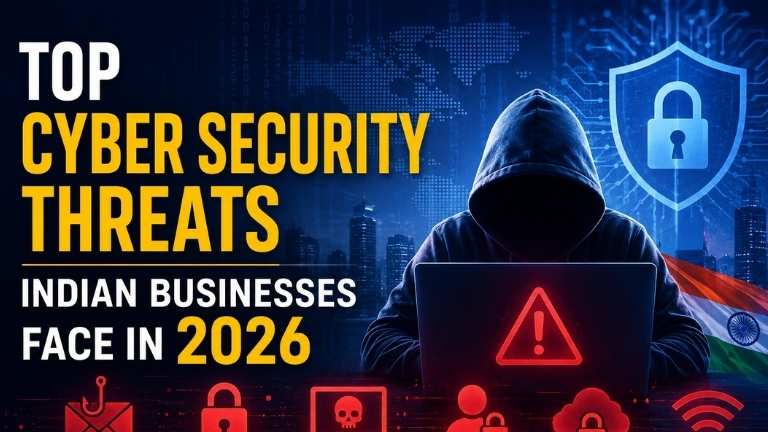
The digital economy of India is growing rapidly, with businesses in all sectors leveraging the benefits gained from technology such as cloud computing, artificial intelligence (AI), the internet-of-things (IoT), digital payment systems, and hybrid working conditions in order to achieve greater efficiency and innovation. However, these advancements provide opportunities for cyber criminals to take advantage of new vulnerabilities through which they can attack and cause disruption to organizations by utilizing one or more of these means.
The digital economy of India is growing rapidly, with businesses in all sectors leveraging the benefits gained from technology such as cloud computing, artificial intelligence (AI), the internet-of-things (IoT), digital payment systems, and hybrid working conditions in order to achieve greater efficiency and innovation. However, these advancements provide opportunities for cyber criminals to take advantage of new vulnerabilities through which they can attack and cause disruption to organizations by utilizing one or more of these means.
In 2026, cyber attacks on businesses will likely significantly increase in number and complexity as a result of their being automated, financially-driven, and targeted. All businesses – from startups and SMEs through Small and Medium Sized Enterprises (SMEs) to large enterprises, and government agencies – are at risk of being attacked using a broad range of methods such as ransomware, phishing, third party supply chain breaches, and insider threat breaches.
Why Cybersecurity Matters More Than Ever in 2026
The digital economy in India is quickly expanding. More and more businesses use digital infrastructure for the everyday operation of their company. Cloud service adoption, remote working models, and the growth of connected devices are creating an ever-increasing attack surface for companies.
- Loss of financial revenue;
- Disruption of business operations;
- Data owned by SMBs being taken illegally;
- Penalties & fines from regulatory bodies;
- Damaged reputations with customers; and
- Loss of trust with their customers.
Top Cyber Security Threats Indian Businesses Face in 2026
1. Cyber Attacks Using AI Technology
The rise of Artificial Intelligence Sales and Solutions (AI) is helping to revolutionize many areas of commerce today; however, businesses are also being adversely affected by cybercriminals who are using AI solutions to launch more advanced, faster cyberattacks. Cybercriminals can write malware that is capable of dynamically adapting to your security defenses, automating reconnaissance activities, and evading detection by traditional antivirus products.
- Monitor all endpoints continuously for unusual activity.
- Make use of behavioral analytics to identify any anomalies in history.
- Regularly update all AI applications with current threat intelligence based on known malware examples.
2. Ransomware Attacks
Ransomware is still one of the most deadly cyberattacks globally in 2026. Cybercriminals encrypt a company’s data and ask the company to pay ransoms for the decryption keys to recover its data. Many ransomware groups now also steal sensitive information before encrypting the company’s files and will threaten to publish the data unless the company pays the ransom.
Healthcare, manufacturing, finance and education remain major targets of ransomware because of the essential services they provide to society.
Ways to prevent:
- Have secure offline backups.
- Use multi-factor authentication (MFA).
- Regularly update operating systems and applications.
3. Phishing and Business Email Compromise (BEC)
Cybercriminals are using Artificial Intelligence (AI) to create intricate attacks that target organizations and deceive employees into transferring funds to or divulging confidential information to cybercriminals.
Cybercriminals will impersonate executives, production vendors, and trusted partners of an organization in Business Email Compromise (BEC) attacks, tricking employees into sending or transferring funds to either of the cybercriminal’s fraudulent accounts by providing these employees with an organization’s executive’s email. BEC attacks may also occur via voice over Internet Protocol (VoIP) phone calls.
Recommendations:
Train your employees in identifying phishing attacks or similar attempts to compromise accounts.
Use multiple methods of communication to confirm any monetary requests.
Implement email authentication certificates for messaging returned from your organization (Policy for SPF, DKIM, and DMARC).
Implement advanced email security to protect against current cybercriminal trends.
4. Supply Chain Attacks
Today’s business operations depend on suppliers, software vendors, and cloud service providers. Cybercriminals tend to target these vendors because it is a way for them to gain access to numerous businesses through one data breach.
Because a poor vendor can give attackers access to your network, supply chain security is important.
To reduce your risk:
- Consider the vendor’s cybersecurity practices.
- Limit access by third parties to your critical systems.
- Continuously monitor the actions of your vendors.
- Include cybersecurity requirements in vendor contracts.
5. Cloud Security Misconfigurations
Cloud usage is on the rise throughout India; however, there are still a large number of breaches due to improperly setup Cloud environments. For example, unsafe access to public storage locations, improper permissions, and lack of monitoring expose Company’s sensitive data.
Most breaches are caused by mistakes made by humans instead of problems inherent in cloud systems.
ENHANCE CLOUD SECURITY WITH THE FOLLOWING RECOMMENDATIONS:
- Enforce the principle of least privilege (PoLP)
- Use encryption when storing data or transferring to/from a Cloud System.
- Perform routine cloud security audits.
- Always monitor your Cloud environments.
Industries Most at Risk in India
- Financial Services and Banking
- Health Care
- Manufacturing
- Information Technology (IT)
- Govt
- Education
- Retail/Ecommerce
- Telecommunications
- Logistics/supply chain
- Energy/utilities
Best Practices to Protect Your Business in 2026
Using a layered security approach can help organizations drastically minimize potential cybersecurity threats by:
- Using endpoint detection and response (EDR) software,
- Encrypting all important business information,
- Conducting regular vulnerability assessments,
- Maintaining offline backup copies,
- Having endpoints monitored continuously,
- Creating incident response plans and exercising them;
- Conducting periodic reviews of their third-party vendors’ cyber security practices.
The Role of EDR in Modern Cybersecurity
Antivirus programs by themselves aren’t enough anymore to protect you from modern cyber threats. Endpoint Detection and Response (EDR) software provides continuous monitoring and analysis of behavior, as well as advanced detection of threats (or attacks), automatic response capabilities (to attacks), and a way to investigate attacks for evidence.
Conclusion
India is experiencing rapid growth in the digital arena and as a result there are many new types of cyber threats that are being developed with greater precision and sophistication than before. With new trends in cyber security such as Artificial Intelligence-based cyber attacks, ransomware attacks, insecure cloud configuration and insider fraud, organisations will face ever more complex security challenges by the year 2026.
By adopting the proactive security approach of leveraging advanced technologies (e.g. Endpoint Detection and Response or EDR), employee training and education, a robust access control system and continuous monitoring, organisations will have an advantage in defending against the evolving landscape of cyber threats over the coming years. Investing in effective cyber security solutions now ensures not only protecting against future attacks, but also helps ensure business continuity; build and maintain trust with customers; and facilitate future growth within our increasingly connected world.
FAQ
1. How important is EDR in 2026?
Through continuous endpoint monitoring and behavioural analyses with automated endpoint threat detection and response capabilities, EDR enables organizations to detect and contain a cyberthreat before significant damage is caused by that threat.
2. What are insider threats?
Insider threats are threats that occur when an employee, contractor, or third-party partner deliberately or accidentally compromises the security of an organization’s assets or exposes sensitive data to unauthorized individuals through the misappropriation of access privileges.
3. What are Common signs of Ransomware Attacks ?
Some usual signals that ransomware may be happening are these: your network speed drops in a strange way, you can’t open certain files or even locate them because they’re locked and encrypted, you notice file names with unfamiliar extensions, you get ransom messages displayed on your computer, your anti-virus protection is turned off or disabled, and/or you start seeing odd, unexpected network traffic. If the ransomware is caught early, it can reduce the chance the attack spreads further, instead of just staying contained.
4. What is Endpoint Detection and Response (EDR)?
Endpoint Detection and Response (EDR) basically is a kind of advanced cyber defense, that keeps watching endpoint devices—think laptops desktops and servers— for unusual or suspicious behaviors. It does not just sit there, it detects those signs, checks what’s going on, and then responds to the threat during the moment. In practice it tends to give more protection than older style antivirus, because it is more attentive and context aware.
5. Which industries in India are most vulnerable to cyberattacks?
In India, the industries that manage sensitive information or depend a lot on online operations tend to be at higher risk. That can include banking and financial services, healthcare, manufacturing, information technology, government organizations, retail and e-commerce, education, telecommunications, plus logistics.
ALSO READ
Seqrite EDR vs Traditional Antivirus
Power Your Business with Reliable Email Services
Power of Partnership Tech IT Cloud and Seqrite in Cybersecurity
How Tech IT Cloud Delivers Enterprise-Grade Security with Seqrite