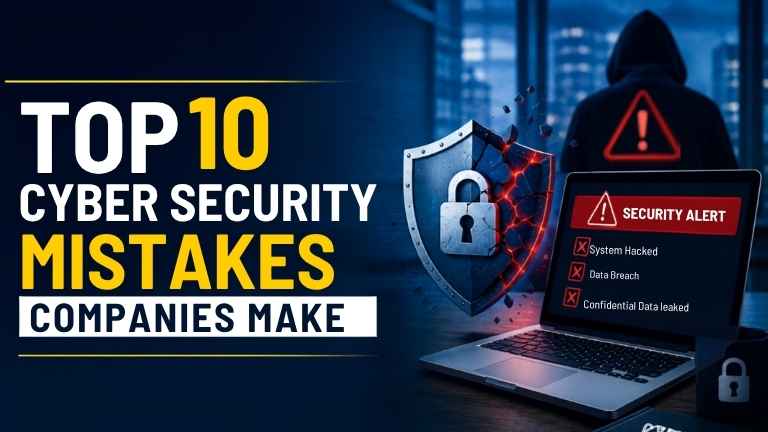
Cyber threats are becoming more advanced as technology becomes more deeply embedded in every part of business operations. As a result, companies of every size are exposed to a growing range of cybercrime, from ransomware and phishing to insider threats. In fact, most successful cyberattacks aren’t the product of elite hacking skill – they succeed because businesses make avoidable mistakes.
Industry surveys consistently point to human error as the root cause of the vast majority of successful cyberattacks. Weak passwords, outdated software, and poor security practices continue to expose companies to significant financial losses, legal consequences, and reputational damage.
Whether you run a startup, an SME, or an enterprise, understanding these ten common mistakes is the first step toward building real cyber resilience.
1. Relying on Antivirus Software Alone
Antivirus software is essential, but it isn’t a complete cybersecurity solution — and too many companies treat it like one. Antivirus tools are good at identifying and removing known malware, but today’s attackers use far more sophisticated techniques, including fileless malware and zero-day exploits that slip past traditional defenses entirely. A single malicious email attachment or a compromised website can be enough to bypass basic protection.
Companies that rely solely on entry-level security tools develop a false sense of safety, leaving them exposed to costly breaches, data loss, and system downtime. What every organization needs instead is a layered security approach, combining endpoint detection and response (EDR), extended detection and response (XDR), network monitoring, anti-phishing tools, and ongoing employee training to recognize threats before they cause damage.
2. Underestimating IT Compliance Requirements
Many businesses overlook the importance of IT compliance standards, exposing themselves to serious legal, financial, and reputational consequences. Regulations like GDPR require organizations to protect confidential data through documented, auditable security practices. Non-compliance isn’t just a technical failure — it can mean regulatory fines, legal action from affected consumers, and lasting damage to customer trust. GDPR penalties alone can reach €20 million or 4% of global annual revenue, whichever is higher.
Staying compliant means understanding exactly what each relevant regulation requires and continuously updating your systems and processes to meet it. Some organizations build this expertise in-house with a dedicated compliance team; others partner with an external compliance provider to monitor systems and manage reporting. Either way, compliance can’t be treated as a one-time checkbox — it requires ongoing attention.
3. Weak Passwords
Weak passwords remain one of the most common — and most preventable — security gaps, even though countless organizations continue to overlook them. Employees often choose simple, memorable passwords, reuse them across multiple accounts, and rarely update them. This makes it easy for attackers to brute-force their way in or use credentials leaked in unrelated data breaches (a technique known as credential stuffing) to gain access.
Once an attacker gets in through a weak password, they can move laterally across a network, exfiltrate sensitive data, deploy malware, or lock legitimate users out of critical systems. Weak passwords are one of the simplest doors for an attacker to walk through, yet many organizations are still slow to enforce stronger password policies.
4. Skipping Third-Party Risk Assessments
Many organizations assume their internal IT security is adequate, but without an independent third-party assessment, that assumption is difficult to verify. Internal teams can become too familiar with their own infrastructure to spot its blind spots, and they may lack the specialized expertise an outside firm brings. Without regular external review, vulnerabilities can go unnoticed until they lead to a data breach, malware infection, or a compliance violation.
As cybercriminal tactics keep evolving, a self-assessment alone often isn’t enough to confirm that data confidentiality and integrity are truly protected. Many compliance frameworks now require independent audits as part of certification, making third-party evaluation not just good practice, but a regulatory necessity in many industries.
5. Overlooking Software Updates
Software updates are often dismissed as minor housekeeping, but skipping them is one of the most common ways companies open themselves up to attack. Outdated operating systems and applications carry known vulnerabilities that cybercriminals actively scan for and exploit — precisely because these attacks are easy to execute and highly effective. The 2017 Equifax breach, which exposed the data of roughly 147 million people, is a well-known example of what can happen when a known, patchable vulnerability is left unaddressed.
Critical patches should be applied as soon as they’re released, and organizations should have a defined patch management process rather than leaving updates to chance.
6. Having No Incident Response Plan
Many businesses underestimate how quickly a cyberattack or data breach can escalate — and how costly hesitation can be. Without a documented Incident Response Plan (IRP) that lays out clear roles, escalation paths, and step-by-step procedures, organizations lose valuable time figuring out how to react in the middle of an active incident. That delay directly translates into higher costs, longer downtime, and greater data loss.
An effective IRP should define who is responsible for what, outline communication protocols (internal and external), and be tested regularly through tabletop exercises — not written once and left in a drawer.
7. Skipping Multi-Factor Authentication (MFA)
Relying on passwords alone, without a second layer of verification, is one of the most common and most fixable security gaps in modern IT environments. Passwords can be cracked through phishing, credential stuffing, or brute-force attacks with relative ease. Once a password is compromised, an attacker can gain direct access to email, financial systems, and other sensitive data — often without triggering any alarms.
MFA adds a second verification step, such as a one-time code or authentication app, that significantly reduces the risk of unauthorized access even if a password is stolen. It’s one of the lowest-cost, highest-impact security controls a company can implement, which makes its absence especially hard to justify.
8. Poor Employee Training
The biggest security risk a company faces often isn’t a technical flaw — it’s human error. When employees aren’t properly trained to recognize phishing attempts, social engineering, or unsafe browsing habits, they become the weakest link in an otherwise well-defended system.
Effective training isn’t a one-time onboarding video. It should include regular phishing simulations, updated guidance as new scam tactics emerge, and clear reporting procedures so employees know exactly what to do when something looks suspicious. Companies that invest in ongoing security awareness training consistently see fewer successful phishing attempts and faster incident reporting.
9. Choosing the Wrong IT Partner
Your IT partner plays a direct role in your company’s cybersecurity, operational efficiency, and long-term stability. Too often, businesses choose a provider based on cost, location, or reputation alone, without carefully vetting their technical expertise or security track record. The wrong IT partner can leave a business unprepared for emerging threats, system outages, or routine technical issues.
The consequences of a poor fit tend to compound over time: prolonged downtime, permanent data loss, and security gaps that go unnoticed until it’s too late. Choosing an IT partner should involve the same due diligence as any other critical vendor relationship — reviewing certifications, response times, and references, not just price.
10. Falling Victim to Cyber Scams
Cyber fraud continues to grow more sophisticated, which makes it harder for businesses to recognize when they’re being targeted. Common tactics include phishing emails, malicious software, and ransomware — frequently disguised using the logos and email addresses of trusted, legitimate organizations.
Because these scams are designed to look authentic, defending against them requires more than technology alone. Companies should train staff to recognize fraudulent messages, deploy email filtering and authentication tools, and run regular phishing simulation exercises. Cybersecurity policies should also be reviewed and updated on an ongoing basis to keep pace with evolving scam tactics.
Conclusion
Cybercrime-related losses are projected to cost the global economy trillions of dollars annually in the coming years. The good news is that avoiding the mistakes above doesn’t require an enormous budget — it requires the right processes, the right training, and the right IT partner. At FunctionEight, we provide a full range of IT support and security services designed to help businesses stay ahead of evolving threats. Years of hands-on experience have shaped our approach to keeping our clients’ systems secure, compliant, and productive.
FAQ
What is the most common mistake companies make regarding cybersecurity?
Assuming that basic antivirus software alone is enough to protect the business.
Why do weak passwords remain a persistent security problem?
Because they’re easy to guess, reuse across accounts, and vulnerable to brute-force or credential-stuffing attacks.
How often should companies update their software? Critical patches should be installed as soon as they’re released, ideally as part of a defined update schedule.
What is Multi-Factor Authentication (MFA)?
A security measure that requires users to verify their identity using at least two independent methods, such as a password plus a one-time code.
Why is employee training so important for cybersecurity?
Employees are typically the first line of defense against phishing and social engineering attacks, so their awareness directly affects the company’s risk level.
Why should organizations conduct independent cybersecurity assessments?
Independent assessments can reveal vulnerabilities that internal teams may miss due to familiarity bias, and they often support compliance requirements tied to industry regulations.
How do regulations affect cybersecurity compliance?
Frameworks like GDPR and ISO 27001 require organizations to implement specific security measures and undergo regular audits to demonstrate compliance.
What steps can organizations take to protect against phishing and cyber scams?
Use advanced email security tools, enable two-factor authentication (2FA), verify suspicious requests before acting on them, provide regular staff training, and keep cybersecurity policies up to date.
DPDP Act Compliance and Cyber Security Requirements
Benefits of Choosing a Seqrite Platinum Partner
Top Cyber Security Threats Indian Businesses
Power of Partnership Tech IT Cloud and Seqrite in Cybersecurity