
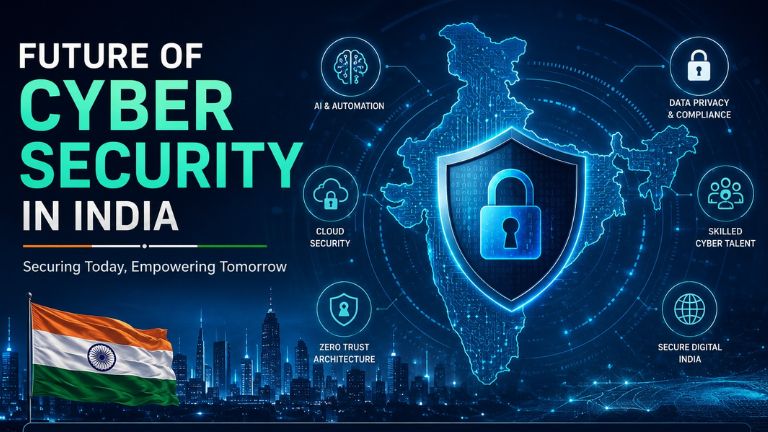
One of the most rapidly progressing digital transformations across the globe is seen in India. Digital technologies have penetrated every aspect of our lives – from mobile banking and UPI transactions to cloud services, AI, smart manufacturing, and e-governance. This quickening digital transformation introduces plenty of opportunities for economic development, but it also opens doors to cybercrime challenges.
With digital transformation taking the businesses and institutions by storm, cybercriminals are adopting new techniques including ransomware, phishing, identity frauds, data breaches, insider threats, or attacks powered by AI. With the increasing reliance of corporations on digital infrastructure, protecting sensitive data and ensuring compliance has become an important focus for organizations today.
Thus, it is clear that the future of cyber security in India will rely on advanced technologies, stronger regulations, highly-skilled professionals, and high awareness of businesses and, therefore, the community in general. Thanks to the initiatives of Digital India, Digital Personal Data Protection (DPDP) Act, smart cities, or Industry 4.0., cybersecurity is emerging as a must-have for businesses rather than just an IT project.
What is Cyber Security?
Cybersecurity means protecting computer systems and networks from illegal access, cyber-attacks, malware, phishing, and other online threats.
A successful cybersecurity approach consists of using technology and combining it with people and processes to achieve the following:
Protection of confidentiality
Integrity of data
Accessibility of systems
Continuity of business
Compliance with regulations
With the pace of digital change speeding up, cybersecurity is crucial for risk management in any organization.
Why Cyber Security is Becoming More Important in India
India has recorded rapid growth in number of internet users, cloud users, digital payments, e-commerce and connected devices. While all these new technologies have played a significant role in making things more convenient and efficient, they have also affected the field of cybersecurity. India has recorded rapid growth in number of internet users, cloud users, digital payments, e-commerce and connected devices. While all these new technologies have played a significant role in making things more convenient and efficient, they have also affected the field of cybersecurity.
Here are a few reasons why cybersecurity has become more important:
- – High speed digital transformation
- – Increased number of cloud users
- – Growth of remote and hybrid working
- – Rising use of IoT devices
- – Rising online financial transactions
- – Digital government services
- – AI apps
- – Growing startup ecosystem
It should be noted that different companies from banking, healthcare, manufacturing, education, retail, telecommunications and logistics industries are investing a lot in protecting their information.
Current Cyber Security Landscape in India
Numerous cyber threats face India, including:
- Ransomware attacks
- Phishing
- Business Email Compromise (BEC)
- Data breaches
- Insider threats
- Cloud security
- Supply chain attacks
- Distributed Denial of Service (DDoS)
- Credential theft
- AI-based cybercrime
Emerging Trends Shaping the Future of Cyber Security in India
1. Artificial Intelligence (AI) and Machine Learning
Artificial Intelligence is revolutionizing the domain of cybersecurity through rapid detection of threats, automated responses, and predictive analytics capabilities.
Security solutions supported by AI are capable of:
- Detecting abnormal behaviors
- Recognizing zero-day attacks
- Automating malware examination
- Minimizing false alerts
- Enhancing threat intelligence
- On the other hand, cybercriminals are using artificial intelligence technology as well to develop more sophisticated phishing attacks and organize their operations more efficiently.
2. Zero Trust Security
Historically, security practices relied on the assumption that users as well as devices within a network would be trustworthy. However, the Zero Trust strategy operates on the “never trust, always verify” principle.
Organizations will always have to authenticate users, devices, and applications before allowing access.
Zero Trust has several benefits that include:
- Stronger identity verification
- Lower likelihood of insider threats
- Improved security for remote work
- Increased protection against lateral movement
Zero Trust is anticipated to be the new security framework for organizations in India.
3. Cloud Security
It is essential to secure cloud infrastructure as companies begin moving workloads to public, private and hybrid clouds.
Here’s what to expect:
– CASBs (Cloud Access Security Brokers)
– CSPMs (Cloud Security Posture Management)
– IAM (Identity and Access Management)
– Data encryption
– Multi-cloud security monitoring
Organizations will invest in cloud-native solutions to safeguard their assets effectively.
4. Cyber Security for Critical Infrastructure
There is a growing interconnection between essential infrastructures – power grids, transportation systems, healthcare facilities, banks, and telecommunication networks.
Protecting vital infrastructure facilities from cyberattacks will have to become a national priority implemented through:
- – Continuous monitoring
- – Exchange of intelligence about threats
- – Planning response actions
- – Security of Industrial Control Systems (ICS)
- – Security of Operational Technologies (OT)
5. Stronger Data Privacy Regulations
In India, the Digital Personal Data Protection (DPDP) Act has drawn attention to the need for securing personal data and also practicing responsible data storage.
Organizations will be required to:
- – Improve access controls
- – Encrypt important data
- – Implement data governance policies
- – Perform risk assessments regularly
- – Enhance incidences response plans
Compliance will become an important factor for investments into the field of cybersecurity.
Why Businesses Should Invest in Cyber Security Today
Today, investing in cybersecurity is a must. This is important for keeping the business running, building confidence among customers, complying with various laws, and protecting sensitive data.
Investing in cybersecurity enables organizations to:
- Decrease the risk of cyber-attacks
- Keep important data safe
- Reduce financial losses
- Increase brand reputation
- Strengthen resilience
- Comply with law requirements
- Assist digital transformation
Taking preventative security measures is much more affordable than addressing a large-scale cyber incident.
Conclusion
India’s future in cybersecurity is interlinked with its digital progress. As businesses start to incorporate cloud technology, Artificial Intelligence, the Internet of Things, and digital services, strong cybersecurity measures will become increasingly necessary. Advanced technologies—such as AI, Zero Trust, XDR, and security automation—will continue to redefine how businesses combat cybercriminals.
At the same time, the emergence of new legislation—such as the Digital Personal Data Protection (DPDP) Act—and increasing awareness in the field of cybersecurity will motivate organizations to invest in their security infrastructure. Companies that put money into modern cybersecurity strategies, cybersecurity training, and risk management systems will be much better prepared for any future challenges.
FAQ
1. What will India’s cyber security look like in the future?
The future of cyber security in India is expected to be impacted by technologies such as artificial intelligence, automation, zero trust photography, improved data protection laws, and cloud security.
2. Why is the importance of cyber security increasing in India?
The relevance of cyber security grows with the expansion of such things as e-commerce, remote work, cloud computing, online government services, etc. The more people and companies depend on technology in
their day-to-day businesses, the higher the probability of hackers’ attacks on them.
3. What are the dangers people face in terms of cyber security in India?
Major challenges include ransomware attacks, phishing scams, insider threats, security breaches, threats related to cloud computing, vulnerabilities of the Internet of Things, etc.
4. How will AI affect cyber security?
AI will improve cyber security through real-time threat detection and response and responsiveness in events of the cyber attacks. However, it should also be taken into account that hackers might abuse the developments in artificial intelligence as well.
ALSO READ