Cybersecurity threats are becoming more sophisticated as we live in a world that is constantly changing due to technology advancements. Firewalls and all other security mechanisms are no longer sufficient for protecting organizations’ data from malicious and external attacks. Today’s employees are often working from home; cloud-based applications are everywhere; and sensitive business data is frequently being transferred across different types of networks.
The changing face of today’s cyber threat landscape has resulted in the rise of Zero Trust Security, considered one of the most effective cybersecurity methods usedby organizations around the globe.
What is Zero Trust Security?
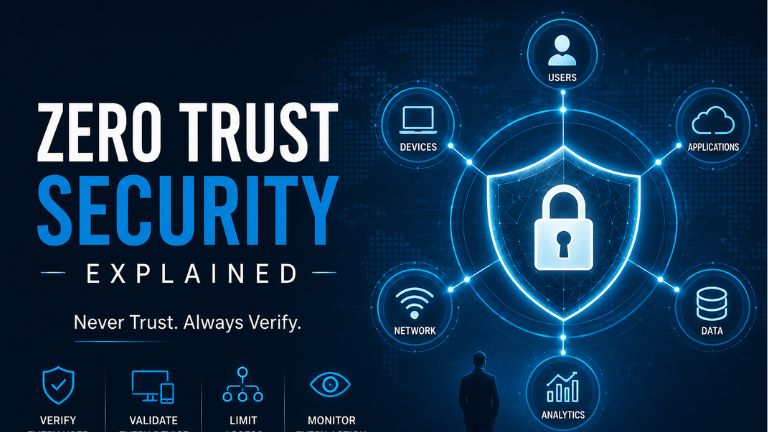
Zero Trust Security is a paradigm for cybersecurity, which means that no user, application, device, or network should ever automatically be assumed to be trusted.
Each and every access request must have multiple security checks performed to verify that request, regardless of the source of that access request.
In essence, traditional security models assume all users that are “inside” the company’s network can be trusted. In contrast to this, many of the current-day cybercriminals are accessing enterprise networks through compromised internal accounts, stolen credentials or compromised devices.
Reasons Why Traditional Security Models Are Outdated
For many years, the security model for most enterprises has been to build a strong perimeter and to keep attackers out of the perimeter while trusting all who possess access inside the perimeter.
The idea was easy to understand:
- Build strong perimeter protection
- Keep all attackers from getting inside the castle
- Trust everything in the castle
Unfortunately, the castle-and-moat security model does not work with today’s work environment.
- Remote workers
- A hybrid work environment
- Cloud-based applications
- Mobile devices
- Third-party vendors
- Internet of Things (IoT) devices
- SaaS
With any single, compromised, internal user account being sufficient for an attacker to move horizontally across the enterprise network, the Zero Trust model stops lateral movement through the enterprise network by checking every single access request to confirm its legitimacy.
Limited Rights to Access
Only the needed access of a user should be granted.
Users will only have access to the selected:
- Files
- Apps
- Data Bases
- Servers
- Resources
This type of access helps to reduce the amount of damage that may occur when a user account has been compromised.
Verification of Devices
Zero Trust is not just limited to the verification of users, but also for verification of devices.
In verifying the device, security checks are performed for:
- Operating System-OS Version
- Security Patches
- Antivirus (up to date)
- Device is encrypted
- Jailbroken/Rooted Devices
- Device has Endpoint Protection
Devices that are untrusted can be automatically denied access.
Continual or Continuous Authentication
Verification of Access is not limited to when an individual logs into the system. The verification process is an ongoing or continual process.
Zero Trust is constantly verifying items for:
- The action the user is taking
- The condition of devices
- The activity on the network
- What user has done previously
- Location of the user
When any suspicious activity is detected, the user’s access can immediately be revoked.
Micro-Segmentation of Network
With the implementation of a Zero Trust network, the network infrastructure will be split into smaller secure segments.
Advantages of Micro-Segmentation include:
Prevents Movement of attackers across the network
Limits Potential Exposure of Data
Provides Better Control of the network
Lessens the Damage from a Breach
Continuously Monitoring
All activity is logged. Logs must be monitored for:
- Login Attempts
- Accessing Files
- Privilege Changes
- Downloading Data
- Device Activity
- Application Use
Complete Visibility is provided to the Organization for all items above.
Benefits of Zero Trust Security
1. Strengthened defense against cybercrime
By requiring continuous verification of user and device identities, Zero Trust makes it significantly more difficult for unauthorized individuals to gain access.
Rather than allowing users to access the network simply by virtue of being in the office, all requests for access are analyzed using multiple security criteria including:
– Identity of the user
– Health of the device
– Location of the login
– Multi-Factor Authentication (MFA)
– Risk level
This means that if cybercriminals gain access to credentials that don’t belong to them, the odds of them being able to take advantage of that access are greatly reduced.
2. Decreased risk of data breaches
Accounts are frequently compromised by cybercriminals who are able to gain access to an account and then move freely throughout the organization, which leaves organizations vulnerable to data breaches that are caused by too much access.
Zero Trust minimizes this risk by only providing access to users based on their needs and not based on their location or the credentials associated with their location.
Some of the benefits of this approach are:
– Limiting the amount of sensitive data that is exposed
– Reducing the number of potential attack vectors
– Protecting sensitive business information
– Controlling access to critical systems
In the event that an attacker is successful in gaining access to an account, they will not be able to easily navigate throughout the network.
3. Avoids lateral movement
In traditional networks, once an attacker gains access to a network they are able to move freely.
The Zero Trust model includes the use of micro-segmentation to break the network into smaller protected areas to ensure that attackers cannot access different systems or spread malware throughout the organization.
This leads to:
– Containing the spread of ransomware
– Containing internal attacks
– Protecting critical assets
4. Extending secure remote access
Organizations are increasingly allowing employees to work remotely; however, this opens them up to increased risk of cybersecurity incidents.
5. Improves Management of Access & Identity
An organization must clearly identify the individual receiving access to a resource in order for that access to be enforced.
Multi-factor authentication (MFA), Single Sign-on (SSO) & password-less access management, in addition to enforcing Role-Based Access Control (RBAC), all contribute to improving the authentication process.
Authentication ensures that only authorized individuals may obtain access to sensitive information.
7. Improve Cloud Security
Today’s organisations use many different platforms for cloud resources as well as SaaS applications.
Continuous validation of users and devices prior to granting permission to access all cloud resources has created secure access to all types of cloud assets.
Benefits associated with secure access to cloud resources include:
Better Access Control
SaaS Application Security
Protection of Data Hosted in Cloud Resources
Reduced Risk of Breaching the Security of Cloud Resources
8. Protect Against Internal Threats
While many threats associated with cybersecurity come from the outside of an organization, there are also many potential threats to your organization from within.
Employees, contractors, and third-party vendors are all capable of accidentally or maliciously providing access to sensitive information within your organization.
Zero Trust effectively minimizes the potential impact of internal threats by:
Restricting Unobstructed Access to Sensitive Resources
Monitoring User Activities
Detecting Anomalies in User Behaviour
Revoking Suspicious Access at the Point of Access
Future of Zero Trust Security
Cybersecurity with a Zero Trust strategy will almost certainly be/continue to be the standard as organizations implement cloud services, artificial intelligence, hybrid work environments and connected devices. In the future, Zero Trust strategies will increasingly include AI driven risk analysis, behavioral analysis, passwordless authentication, and automated rule enforcement in order to provide greater protection with the least amount of inconvenience to users.
Conclusion
Organizations now have a new approach to protecting their digital assets: the concept of Zero Trust Security. This approach no longer relies on the “trusted network” for security. Instead, all users, devices and applications requesting access to resources are required to authenticate each other. Using continuous verification, least-privilege access, strong identity management and ongoing monitoring, businesses will greatly reduce their likelihood of experiencing a data breach, being attacked by ransomware or suffering from an insider-related security incident.
FAQ
1. What is the best thing about Zero Trust Security?
Zero Trust continuously verifies every access request which helps limit unauthorized access and the chance of a data breach.
2. How does Zero Trust enhance security for remote work?
Zero Trust authenticates users and devices no matter where they are located, providing secure access to remote workers and hybrid employees.
3. Can small businesses utilize a Zero Trust model?
Small business can utilize Zero Trust concepts such as Multi Factor Authentication (MFA), Least Privilege Access (LPA), or Continuous Monitoring to achieve enhanced security without requiring costly IT systems.
4. Can Zero Trust completely remove Cyber Attacks?
No security framework will completely eliminate all cyber threats, but utilizing a Zero Trust model will reduce the chances and impact of any successful attacks.
5. Why is continuous monitoring crucial to Zero Trust?
Through continuous monitoring, organizations can detect abnormal activity in real-time which enables them to act swiftly before any significant damage is done by an attacker(s).
6. Is a Zero Trust framework appropriate for a cloud environment?
Yes. Zero Trust was designed specifically to protect Cloud applications, SaaS platforms, hybrid infrastructures, by providing continuous authentication and access management.
7. How does Zero Trust help organizations achieve compliance regulations?
Zero Trust improves authentication and access management systems, as well as logging and protection of data, which helps organizations comply with many data privacy/security regular.
ALSO READ