
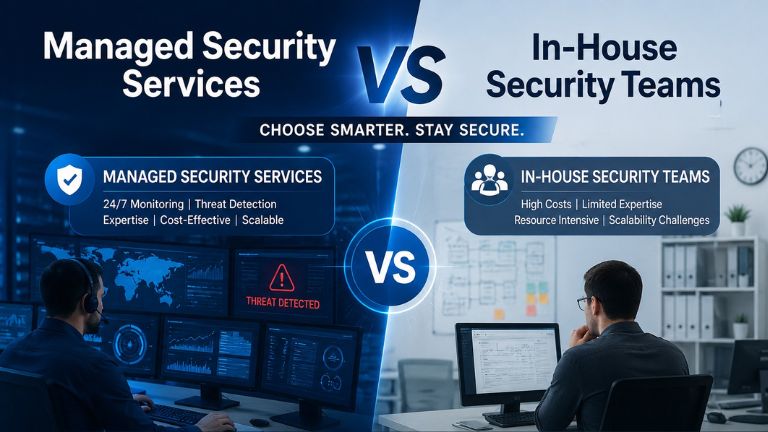
As the cyber threats are evolving continuously, companies of every nature are feeling the strain of protecting their precious assets, customer information, and critical IT infrastructure. From malware and phishing attacks to insider threats and cloud vulnerabilities, firms are dealing with increasing number of cyber threats on a daily basis. One successful attack may bring significant monetary losses, reputation damage, penalties due to non-compliance with regulations, and interruptions in operational processes.
To enhance their cybersecurity defense, organizations are mostly able to choose between two alternatives: Managed Security Services (MSS) and In-House Security Teams. While the establishment of an in-house security team allows organizations to have complete control over the security process, Managed Security Service Providers (MSSPs) can provide firms with required equipment and specialists without expenses of establishing a full-scale internal department.
What Are Managed Security Services?
Managed Security Services are cybersecurity solutions that rely on a Reliable Security Provider. The specialist in question is called Managed Security Service Provider (MSSP), which has expertise in monitoring and securing an organization’s information technology infrastructure by deploying professional manpower and technology.
Some examples of Managed Security Services include:
– Round-the-clock surveillance
– Security Operation Centers
– Threat identification
– Endpoint detection
– Advanced methodology for threat detection and prevention
– Firewall management
– Breaking detection and prevention
– Vulnerability evaluation
– SIEM
– Cloud protection
– Emergency situation handling
– Provision of compliance services
MSSPs serve as an integral part of your information technology team and keep you safe from constantly evolving threats.
What Is an In-House Security Team?
In-house security personnel are cybersecurity experts hired by a company directly. Their work includes the planning, execution, supervision, and management of the organization’s cybersecurity process.
Some of the functions typically assigned to in-house teams include:
- Creation of security policies
- Conducting risk assessments
- Monitoring threats
- Responding to incidents
- Providing network security
- Ensuring endpoint protection
- Managing identity and access
- Conducting security awareness training for employees
- Overseeing compliance issues
- Implementing security audits
In big companies, there is usually a team of security operations personnel with the necessary qualifications.
Benefits of Managed Security Services
1. 24/7 Security Monitoring
Cyberattacks don’t really care about timing. MSSPs handle monitoring , day and night, so they can detect and respond to threats before things start snowballing
2. Access to Cybersecurity Experts
Managed service providers bring in seasoned security analysts , engineers, and threat intelligence specialists. These people keep on top of the latest attack methods , and also the defense strategies that actually work
3. Lower Operational Costs
Putting together an internal cybersecurity team takes serious spend—hiring , salaries, ongoing training, software licenses, and then the infrastructure too. MSS gives you enterprise-level coverage for a more stable , monthly cost. Which is kinda the point really
4. Faster Threat Detection and Response
With modern tooling like SIEM, EDR, XDR, and automated response platforms, MSSPs can spot weird behavior rapidly and then contain it, before it turns into major damage
5. Access to Advanced Security Technologies
MSSPs put money into current cybersecurity platforms, so businesses can use enterprise protection without having to buy, manage and maintain every expensive security tool on their own
Challenges of Managed Security Services
Even though MSS gives a lot of upside, companies still may want to think about a few other things too, like
There’s also a need for really clear Service Level Agreements (SLAs), to spell out who does what and what to expect.
Less direct control over day to day security operations.
A real dependence on how good the provider is, plus their response times.
Sometimes there can be communication delays when critical incidents happen.
Future of Managed Security Services
1. AI-Enabled threat detection
Artificial intelligence, and machine learning will end up carrying a big share in where Managed Security Services go next . AI driven security platforms can parse huge volumes of activity in real time, notice strange patterns, surface potential threats, and then automate the response. that combo makes detection quicker and more accurate overall , especially when something “odd” is happening across many systems at once.
2. More take-up of Managed Detection and Response (MDR)
A lot of organizations are drifting away from basic monitoring services and leaning into Managed Detection and Response (MDR) instead . MDR blends advanced threat detection, threat hunting, incident investigation, and rapid response, so companies get a stronger shield against more elaborate cyberattacks, not just the common ones.
3. Cloud security services keep growing
Since more groups migrate to public, private , and hybrid cloud setups, MSSPs will expand cloud centric offerings . think cloud monitoring, identity and access management (IAM), cloud security posture management (CSPM), and cloud workload protection too, all aimed at keeping important business data guarded.
4. Zero Trust security shows up everywhere
The Zero Trust security model will likely become a central part of Managed Security Services . MSSPs will assist with continuous identity verification, least-privilege access, and network segmentation. The goal is to trim down the odds of unauthorized access or sneaky insider threats, even when the environment changes often.
5. More security automation, less busywork
Automation helps MSSPs compress repetitive security chores, like vulnerability scanning, patch management, alert prioritization, and incident response . that improves efficiency , shortens the response window, and lets security specialists spend more time on the tougher, less predictable threats.
Conclusion
Both Managed Security Services, and In-House Security Teams play a important role in protecting organizations from cyber threats. The right choice kinda depends on your organization’s size , budget, security maturity, compliance obligations, and also operational requirements.
Managed Security Services can be more cost-effective, because they give you access to expert talent, advanced technologies, and 24/7 monitoring. So it can work really well for small and medium-sized businesses that want scalable protection, without having to build everything from scratch.
On the other hand, an in-house security team gives more control, deeper organizational knowledge and more customized security management. That arrangement is often more suitable for larger enterprises, especially those with dedicated resources and the ability to run things internally, day to day.
FAQ
1. What is the future of Managed Security Services (MSS)?
The future of Managed Security Services kind of revolves around AI powered threat detection, security automation, cloud security, Zero Trust design, and Managed Detection and Response (MDR). Since cyber threats keep getting more complex, companies will probably lean more on MSSPs for proactive, round-the-clock cybersecurity coverage, even when nobody on the business side is watching screens all the time.
2. Why are Managed Security Services becoming more popular?
Managed Security Services are getting more attention because they bring specialist cybersecurity help, continuous observation, sharper threat identification, quicker incident handling, and security that feels more economical, without needing to set up and maintain a big internal security squad. Also, the operational burden is lower, which businesses do like.
3. How will Artificial Intelligence improve Managed Security Services?
Artificial Intelligence (AI) is going to support Managed Security Service Providers (MSSPs) by sifting through huge piles of security signals, spotting odd behavior in real time, and then triggering automated countermeasures. It should also lower false positives, and help teams notice new kinds of cyber threats sooner and with more precision.
4. Can Managed Security Services help businesses meet compliance requirements?
Yes, in practice they can. Managed Security Service Providers help organizations satisfy regulatory and industry compliance obligations like ISO 27001, the Digital Personal Data Protection (DPDP) Act, GDPR, HIPAA, and PCI DSS. They do that by putting in security controls, running monitoring systems, keeping audit trails, and supporting compliance documentation too. So, the evidence is more organized, not just “best effort”.