
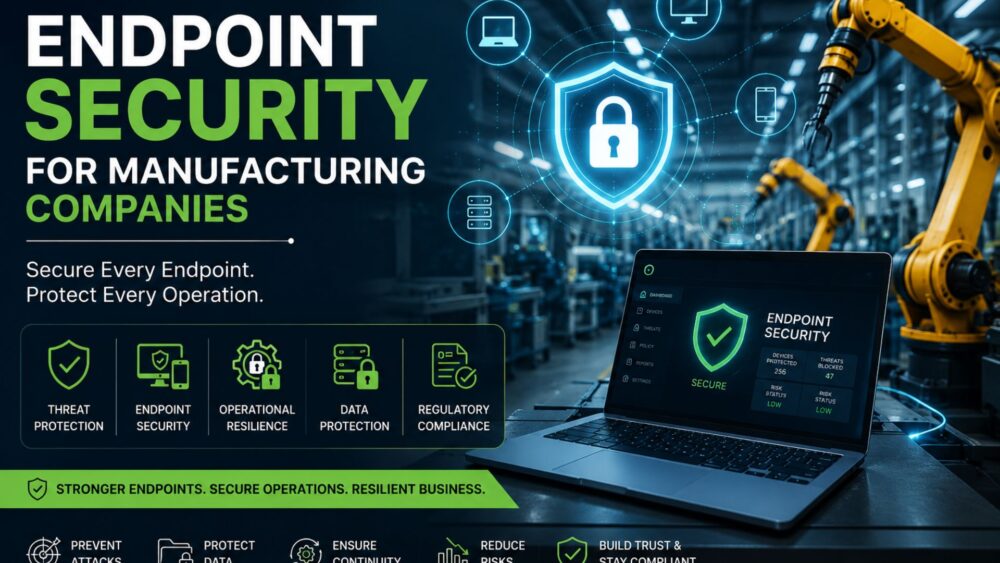
The manufacturing sector has gone through a serious digital transformation in recent times. Smart factories, the concept of Industrial Internet of Things (IIoT), cloud computing, robotics, automated production line solutions, ERP systems, and connected supply chains have all made a substantial impact on the manufacturing processes.
All connected devices in the manufacturing field, which would include the employee’s laptops and computers, CNC machines, Industrial Control Systems(ICS) and Programmable Logic Controllers (PLC), barcode scanners, handheld terminals (HHT), engineer workstations, mobile devices and remote monitoring devices, create a new entry point for cyber criminals.
At this point, the solutions provided by Endpoint Security for Manufacturers come in handy. The concept of endpoint security provides comprehensive protection for all connected devices and facilitates the manufacturing companies in detection, prevention and mitigation of cyber threats.
What is Endpoint Security?
Endpoint Security is a cybersecurity solution that aims to safeguard endpoints associated with a company’s network. Endpoints may consist of desktop computers, laptops, servers, smartphones, industrial machines, and operations technology (OT) systems.
Unlike traditional forms of anti-virus software, modern endpoint security applies artificial intelligence (AI), behavioral analytics, machine learning, threat intelligence, and real-time surveillance systems to identify known and unknown security threats from the Internet.
In the case of manufacturing companies, endpoint security helps in protecting important production systems, intellectual property, and operational continuity of the business.
Why Manufacturing Companies Need Endpoint Security
A number of enterprises focused on manufacturing are being targeted presently as they depend on the continuous process of operation and handle intellectual property and other sensitive data.
Cybercriminals can:
• Use ransomware to encrypt production equipment
• Get access to confidential designs
• Make disruptions in the production process
• Obtain information about the clientele
• Spread malware across factory networks
• Use vulnerable industrial devices
• Inflict losses on the business
The compromised endpoint can impact the entire production cycle; therefore, protection of endpoints is essential for any organization.
Common Endpoint Devices in Manufacturing
Manufacturers usually run several connected devices, which include the following:
• Desktops
• Laptops
• Workstations
• CNC machine controllers
• PLCs and HMIs
• Industrial PCs
• Production servers
• Barcode scanners
• Mobile phones
• Tablets
• Warehouse terminals
• Internet sensors
• Quality control systems
• Equipment used for distance maintenance
These endpoints all require constant surveillance.
Major Cyber Threats Facing Manufacturing Companies
1. Ransomware Assaults
Ransomware leads to the messaging of data files and records, thus forbidding entering until the ransom is disbursed. Manufacturing firms often become the targets of ransomware since the downtime for production entails significant financial losses.
2. Phishing Assaults
Cheating emails would be sent by cybercriminals with concerns to trick the workers into leaking their passwords or running malicious software programs, etc.
3. Malicious Software Programs
There are viruses, worms, spyware, trojans, etc. which can harm the systems, steal some data, etc.
4. Internal Dangers
It is possible for the employees and contractors to disclose sensitive information, either by fault (unintentionally) or consciously.
5. Supply Chain Dangers
Cybercriminals get into manufacturing systems through third-party organizations and updates.
6. Zero-day Exploitation
A fresh exploitation of software problems occurs.
Benefits of Endpoint Security for Manufacturing Companies
1. Safeguards Production Systems
With the advent of endpoint security, industrial applications, technological workstations, and establishing systems are shielded from adversary attacks that would be costly and disruptive to production.
2. Stops Ransomware
Advanced detection mechanisms are capable of identifying ransomware prior to the encryption of data files thereby minimizing the potential downtime and losses.
3. Enhances Ownership of Intellectual Property
Manufacturers need to secure their trade marks, CAD models, product designs, and engineering notes from illicit exploitation.
4. Better Business Continuity
Constant monitoring of information security trends ensures that production activities will not be disrupted.
5. Increases Degree of Compliance
Application of endpoint devices enables compliance with the latest information security standards and requirements.
6. Minimizes Downtime
With the help of attacks and countermeasures detection systems, disruptions of manufacturing processes will be kept to the minimum.
7. Supports Cybersecurity of Remote Employees
Provides protection to employees operating remotely while negotiating factory and ERP systems as well as using cloud applications.
8. Boosts Security of the Supply Chain
Monitoring suppliers’ access into systems as well as security of connected devices lowers cyber risks related to third-party supply chain.
Best Practices for Implementing Endpoint Security
- Deploy endpoint security on every connected device.
- Keep operating systems and software up to date.
- Enable multi-factor authentication (MFA).
- Conduct regular employee cybersecurity awareness training.
- Restrict administrative privileges.
- Monitor endpoint activity continuously.
- Perform regular vulnerability assessments.
- Back up critical manufacturing data.
- Segment IT and OT networks.
- Test incident response plans periodically.
How to Implement Endpoint Security in a Manufacturing Company
Step 1: Evaluate The Current Network
Recognize all existing endpoints, operating systems, and production devices connected.
Step 2: Assess Threats
Assess the possible cyber attacks, weaknesses and critical business systems.
Step 3: Choose the Appropriate Endpoint Security System
Find the system that is capable of managing production technology, working with current software as well as centralizing control.
Step 4: Make Use of All Endpoints
Implement the system on office technologies, technological equipment, engineers’ workplaces, servers and mobile devices.
Step 5: Configure Security Rules
Define the rules for application management, device handling, access privileges, and incident response.
Step 6: Train Employees
Teach your employees to distinguish phishing and use security measures.
Step 7: Monitor and Optimize
Constantly check security events, conduct constant updates and adapt rules according to the changes in threats.
Choosing the Right Endpoint Security Solution
When assessing endpoint security solutions, one has to consider these aspects:
- The use of artificial intelligence in threat detection
- Endpoint Detection and Response (EDR)
- Protection against ransomware
- Centralized management interface
- Deployability in Cloud
- Control over devices and USBs
- Managing patches of software
- Compatibility with multiple manufacturing locations
- Integrating with SIEM and SOC solutions
- Round the clock assistance
Future Trends in Manufacturing Endpoint Security
The development of endpoint security will be influenced by advancements in AI, automation, and convergence with technologies from Industry 4.0. Here are some emerging trends:
- Autonomous threat response based on AI
- Extended Detection and Response (XDR)
- Zero Trust security architecture
- Cloud-native endpoint security
- Integration with IoT and OT
- Predictive threat intelligence
- SOAR (Security orchestration and automation)
With the increased connectivity of manufacturing environments, endpoint security will be essential for safeguarding digital operations and securing resilience of businesses.
Conclusion
As companies in the manufacturing sector are increasingly relying on automation, smart factories, and interconnected industrial systems, cybersecurity has been elevated to the top of the list of business priorities. Each connected endpoint, including the laptops of employees, engineering workstations, industrial controls, and IoT devices, can represent an opportunity for cyberattacks. The implementation of an efficient endpoint security clearing ensures that manufacturers will be able to protect their sensitive data, avoid ransomware, reduce production delays, and ensure business continuity.
FAQ
1. What is meant by endpoint security in the manufacturing industry?
Endpoint security ensures that every connected device including the production system, server, industrial computers, and laptops is secured against cyber attacks with advanced detection, response, or monitoring systems.
2. Why should manufacturers consider endpoint security?
Manufacturers tend to leverage modern automation technology that makes their operations dependent on the connected manufacturing devices or business data. Using endpoint security helps them avoid cyber attacks by ensuring that the organization does not fall victim to the application of different viruses, or face operational interruptions.
3. How is endpoint security different from antivirus?
Traditional antivirus solution works only through identifying the presence of a virus, while endpoint security gives such benefits as real-time monitoring, threat detection using AI, incident response, centralized management, or behavior analysis.
4. What endpoint devices should be secured?
Employees’ computers, engineering workstations, servers, CNC machine controllers, industrial computers, mobile devices, and bar codes should all be protected with the use of endpoint security.
5. Can endpoint security help to prevent ransomware attacks?
Yes. The modern endpoint security systems take advantage of the machine learning, behavioral analysis to avoid unauthorized access to the critical company information before the files are encrypted
ALSO READ