In today’s digital world, cyber threats seem to be getting more clever and popping up more often than before. Companies, from the smallest setups to bigger ones, run into all kinds of dangers like ransomware hits, phishing attempts, malware infections, some kind of unauthorized entry, and yes, data breaches too. Even one successful cyberattack can turn into serious money loss, long operational pauses, reputational harm, and legal trouble. And as more organizations lean into cloud computing, remote work, and digital change, keeping network infrastructure safe has become like, a top concern.
A firewall, honestly, acts as the first barrier against these threats by watching, filtering, and restricting network traffic. But traditional firewalls, they’re just not enough anymore when attackers use more advanced tactics. Most modern teams really need next-generation firewall, sometimes called NGFW, options that add intelligent threat detection, application control, intrusion prevention, web filtering, and extra security layers that feel more proactive.
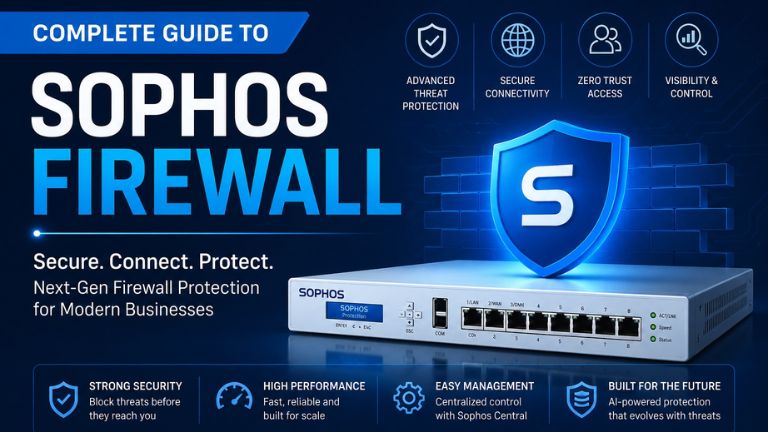
Sophos Firewall is widely used, kind of one of the better known NGFW choices that many businesses trust worldwide. It brings together strong security features with centralized control, AI-driven threat intelligence, deep packet inspection, VPN support, and smooth linking with endpoint protection. Whether you’re supporting a small company, a big enterprise, a school environment, or a government unit, Sophos Firewall gives broad network security meant to guard your important data and digital belongings.
What is Sophos Firewall?
Sophos Firewall is a Next-Generation Firewall (NGFW) developed by Sophos, a globally recognized cybersecurity company. It is designed to secure networks by monitoring, filtering, and controlling incoming and outgoing traffic while protecting organizations from advanced cyber threats.
Unlike traditional firewalls that only allow or block traffic based on IP addresses and ports, Sophos Firewall provides intelligent security by analyzing applications, users, web traffic, encrypted connections, and network behavior in real time.
Sophos Firewall integrates multiple security technologies into a single platform, including:
- Intrusion Prevention System (IPS)
- Web Filtering
- Application Control
- VPN Connectivity
- Malware Protection
- Advanced Threat Protection (ATP)
- SSL/TLS Inspection
- Sandstorm Cloud Sandboxing
- Email Protection
- Zero-Day Threat Detection
- Traffic Shaping
- SD-WAN Support
Its intuitive dashboard makes network management simple, allowing administrators to monitor traffic, detect threats, and enforce security policies from one centralized console.
Sophos Firewall is available as:
- Hardware Appliance
- Virtual Firewall
- Cloud Firewall
- Software Firewall
This flexibility makes it suitable for businesses of every size
Why is Sophos Firewall Important?
Cybersecurity has become a business necessity rather than an IT requirement. Every connected device, employee laptop, cloud application, and remote user represents a potential entry point for attackers.
Sophos Firewall helps organizations protect themselves from modern cyber risks while ensuring business continuity.
Protects Against Cyber Attacks
Sophos Firewall blocks:
- Malware
- Ransomware
- Spyware
- Phishing attacks
- Botnet communication
- Zero-day threats
- Network intrusions
Its real-time protection continuously scans network traffic to detect suspicious activities before they cause damage.
Prevents Unauthorized Access
Sophos Firewall controls who can access your network.
Administrators can define policies based on:
- Users
- Departments
- Applications
- Devices
- Locations
- Time schedules
This ensures only authorized users gain access to sensitive business resources.
Secures Remote Workforce
With hybrid and remote work becoming the norm, organizations require secure remote access.
Sophos Firewall offers:
- SSL VPN
- IPSec VPN
- Remote user authentication
- Multi-factor authentication
- Secure branch connectivity
Employees can safely access company resources from anywhere.
Ensures Regulatory Compliance
Many industries must comply with standards like:
- ISO 27001
- GDPR
- HIPAA
- PCI DSS
- NIST
- DPDP Act (India)
Sophos Firewall provides logging, reporting, encryption, and access controls that support compliance requirements.
Improves Network Visibility
The firewall offers complete visibility into:
- Internet usage
- User activity
- Applications
- Connected devices
- Threat reports
- Bandwidth consumption
This helps IT teams make informed security decisions.
Key Features of Sophos Firewall
Sophos Firewall offers numerous enterprise-grade security features designed to provide complete network protection.
1. Deep Packet Inspection (DPI)
Sophos Firewall inspects every data packet entering or leaving the network.
Unlike traditional firewalls, DPI analyzes:
- Packet contents
- Applications
- Malware signatures
- User identity
- Traffic behavior
This enables more accurate threat detection.
2. Intrusion Prevention System (IPS)
The integrated IPS continuously monitors network traffic for known attack patterns.
It blocks:
- SQL Injection
- Cross-Site Scripting (XSS)
- Buffer Overflow Attacks
- Remote Code Execution
- Exploits
- Port Scanning
This prevents attackers from exploiting vulnerabilities.
3. Web Filtering
Organizations can control employee internet usage by allowing or blocking specific websites.
Administrators can restrict:
- Social Media
- Gambling
- Adult Content
- Torrent Sites
- Malicious Websites
- Unauthorized Downloads
This enhances productivity and reduces security risks.
4. Application Control
Sophos Firewall identifies thousands of applications regardless of the ports they use.
Examples include:
- Skype
- Zoom
- Dropbox
- BitTorrent
- Netflix
Businesses can block or prioritize applications based on their security policies.
5. SSL/TLS Inspection
Today, most internet traffic is encrypted.
Sophos Firewall decrypts SSL traffic, scans it for malware and threats, and then re-encrypts it before sending it to users.
This prevents hidden malware from bypassing security controls.
6. Advanced Threat Protection (ATP)
ATP identifies compromised devices attempting to communicate with malicious servers.
If suspicious activity is detected, Sophos Firewall automatically isolates infected devices to stop malware from spreading across the network.
7. VPN Connectivity
Sophos Firewall supports secure remote access using:
- SSL VPN
- IPSec VPN
- Site-to-Site VPN
- Client VPN
Businesses with multiple offices can securely connect all locations.
8. SD-WAN Capabilities
Organizations using multiple internet providers can optimize network performance through intelligent traffic routing.
Benefits include:
- Reduced latency
- Improved application performance
- Automatic failover
- Better bandwidth utilization
9. Centralized Management
Using Sophos Central, administrators can:
- Manage multiple firewalls
- Create security policies
- Monitor threats
- Generate reports
- Update firmware
- Configure VPNs
Everything is accessible through a single dashboard.
10. AI-Powered Threat Intelligence
Sophos continuously updates its threat database using artificial intelligence and global threat intelligence.The firewall automatically blocks newly discovered malware and attack techniques before they impact the network.
Types of Sophos Firewall
Sophos offers different firewall deployment options to suit diverse business needs.
1. Hardware Firewall
A dedicated physical appliance installed within an organization’s network.
Best for:
- Medium businesses
- Large enterprises
- Manufacturing
- Hospitals
- Educational institutions
Advantages:
- High performance
- Dedicated processing power
- Maximum security
- Easy deployment
2. Virtual Firewall
A software-based firewall installed on virtualization platforms such as VMware, Hyper-V, or KVM.
Ideal for organizations operating virtual data centers.
Benefits include:
- Lower hardware costs
- Flexible deployment
- Easy scalability
- Efficient resource utilization
3. Cloud Firewall
Designed for cloud environments like:
- Microsoft Azure
- Amazon Web Services (AWS)
- Google Cloud Platform (GCP)
It secures cloud workloads while maintaining consistent security policies across hybrid infrastructures.
4. Software Firewall
Organizations can install Sophos Firewall directly on compatible server hardware.
Suitable for businesses seeking enterprise-grade protection without investing in proprietary firewall appliances.
How Sophos Firewall Works
Sophos Firewall operates by inspecting every packet of data entering and leaving your network. Instead of relying solely on traditional port-based filtering, it uses deep packet inspection, user awareness, application intelligence, and real-time threat detection to make security decisions.The process begins when internet traffic reaches the firewall. Sophos first identifies the source, destination, user, application, and protocol associated with the traffic. It then compares this information against predefined security policies, reputation databases, and threat intelligence feeds.
If the traffic is legitimate, it is allowed to pass through. If it contains malicious code, suspicious behavior, or violates organizational policies, the firewall immediately blocks the connection and records the event for further analysis.
For encrypted traffic, Sophos Firewall performs SSL/TLS inspection by decrypting the traffic, scanning it for malware and threats, and then re-encrypting it before forwarding it to its destination. This ensures that hidden attacks cannot bypass security simply because they are encrypted.
Additionally, Sophos Firewall works closely with Sophos endpoint security solutions through synchronized security. If an endpoint becomes infected, the firewall can automatically identify the compromised device, isolate it from the network, and prevent the threat from spreading to other systems.
With continuous monitoring, intelligent threat detection, and centralized management, Sophos Firewall provides businesses with a proactive, layered approach to network security, ensuring that users, devices, applications, and sensitive data remain protected against evolving cyber threats.
Conclusion
Sophos Firewall is not just another network security thing, it’s this comprehensive, Next-Generation Firewall (NGFW) that guards modern businesses from the most sophisticated cyber threats out there. It comes with strong features like deep packet inspection, intrusion prevention, application control, web filtering, VPN support and a lot more, plus AI driven threat intelligence and synchronized security so the whole setup works in layers, not just one defense and done.
For small teams all the way up to bigger enterprises, Sophos Firewall gives scalability, solid performance, and centralized management, so different security needs can be handled without guesswork. You get real time threat detection, dependable remote access, and smooth integration with both cloud security and endpoint protection tools. That makes it a pretty natural pick for organizations pushing forward with digital transformation, even when the environment is constantly changing.
And when you actually invest in Sophos Firewall you’re improving your overall cybersecurity posture while also supporting business continuity, regulatory compliance, and keeping user work moving. If it’s deployed through a certified Sophos partner, who makes sure everything is properly configured, and who can provide ongoing support, then the organization tends to get maximum use from the valuable investment made in that Sophos Firewall solution. In an ever evolving threat landscape, Sophos Firewall feels like a future-ready security approach, worth considering, for that extra peace of mind.
FAQ
1. What is Sophos Firewall, and how does it protect my business?
Sophos Firewall is a Next-Generation Firewall (NGFW) that secures your network by monitoring and filtering incoming and outgoing traffic. It protects businesses from cyber threats such as malware, ransomware, phishing attacks, unauthorized access, and data breaches using advanced features like intrusion prevention, web filtering, application control, and AI-powered threat detection.
2. Who should use Sophos Firewall?
Sophos Firewall is suitable for organizations of all sizes, including small businesses, medium-sized enterprises, large corporations, educational institutions, healthcare providers, government agencies, and retail businesses. It offers scalable security solutions that can be tailored to meet different business requirements.
3. What are the key features of Sophos Firewall?
Sophos Firewall includes a wide range of advanced security features, such as:
- Deep Packet Inspection (DPI)
- Intrusion Prevention System (IPS)
- Web Filtering
- Application Control
- SSL/TLS Inspection
- VPN (SSL & IPSec)
- SD-WAN
- Advanced Threat Protection (ATP)
- AI-powered Threat Intelligence
- Centralized Management through Sophos Central
4. Can Sophos Firewall support remote and hybrid work environments?
Yes. Sophos Firewall provides secure remote access through SSL VPN, IPSec VPN, and Multi-Factor Authentication (MFA). These features allow employees to securely connect to the corporate network from any location while protecting sensitive business data from cyber threats.
5. Why should I purchase Sophos Firewall from a certified Sophos Partner?
A certified Sophos Partner provides expert consultation, proper firewall sizing, professional installation, customized security policy configuration, firmware updates, technical support, and ongoing maintenance. This ensures your Sophos Firewall is deployed correctly and delivers maximum security and performance for your organization.