
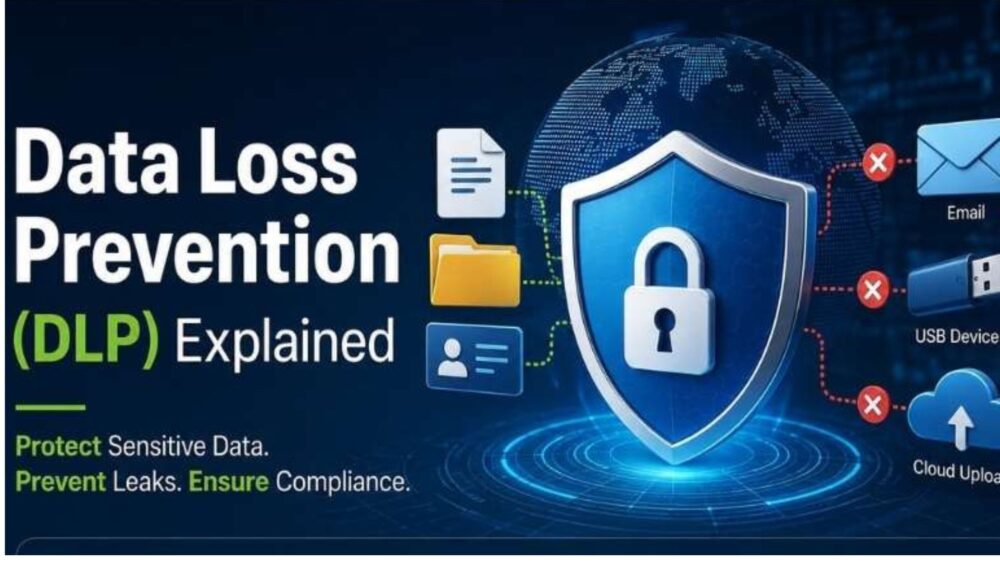
In the current digital era, data is regarded as one of the most important assets that a company possesses. Companies collect and keep date regarding customers, accounting information, patents, business agreements, and more.Nevertheless, with the increase in cybercrime, insider threats, accidental data leaks, and remote work, protection of sensitive information has become more difficult. This is where Data Loss Prevention comes in.
Data loss prevention is a security strategy that enables enterprises to detect, monitor, and prevent unauthorized access to sensitive information, thus making sure that data is safe when being processed, saved, or moved such that the information is protected at all times.
What is Data Loss Prevention (DLP)?
Data Loss Prevention is comprised of the technologies, policies, and processes that are all used to prevent sensitive data being lost, stolen, misused, or exposed to unauthorized people.
A DLP solution will continuously monitor business data in order to identify confidential information such as:
- Customer personal information
- Financial records
- Employee data
- Healthcare records
- Intellectual property
- Trade secrets
- Business contracts
- Legal documents
When sensitive data is shared through channels that are not permitted or accessed by unauthorized users, the DLP system will automatically block, notify, or encrypt the data.
Why is Data Loss Prevention Important?
Businesses today face multiple risks that can lead to data loss, including:
- Cyberattacks
- Ransomware
- Insider threats
- Employee negligence
- Lost or stolen devices
- Misconfigured cloud storage
- Unauthorized file sharing
- Third-party security risks
A single data breach can result in financial losses, legal penalties, reputational damage, and loss of customer trust.Implementing a robust DLP strategy helps organizations minimize these risks while maintaining compliance with industry regulations.
How Does Data Loss Prevention Work?
The DLP system operates by constantly scrutinizing information present in the company’s IT ecosystem.
The general work process consists of:
1. Detecting Sensitive Data
The program checks files, messages, databases, cloud storage, and gadgets to find confidential material.
It applies certain rules, expressions, types of documents, and processes of information classification in order to find any sensitive information.
2. Classifying Data
Once the sensitive information is detected, DLP monitors its degree of significance.
For instance:
- Public Information
- Internal Information
- Confidential Information
- Highly Confidential Information
- The kind of the information being classified will determine its processing.
3. Tracking the Activity with Data
The DLP technology monitors the following:
– File shifts
– Email attachments
– USB devices
– Cloud storage
– Printing operations
– Screenshotting
– Copy-pasting
The activity that raises some doubts will be questioned immediately.
4. Enforce Security Policies
Organizations make security policies depending on the needs of their business.
For instance:
Prohibit external email communication of sensitive documents.
Restrict the copying of important documents onto USB devices.
Prevent uploading of financial documentation onto personal cloud platforms.
Encrypt sensitive documents before sharing them.
Policies from DLP systems are enforced automatically.
5. Send notifications and reports.
Whenever a violation occurs, a notification is sent to the organization’s security teams.
Types of Data Loss Prevention
1. Network DLP
Network Data Loss Prevention oversees data traversing company networks.
It stops the unlawful transfer of confidential information via emails, websites, messaging apps, or network traffic.
2. Endpoint DLP
Endpoint DLP offers safeguarding of computers, laptops, and mobile gadgets.
It has the ability to stop users from the following actions:
Transferring data to USB devices
Making any copies of sensitive records
Putting files onto insecure cloud platforms
Distributing sensitive data with personalized apps
3. Cloud DLP
Since organizations began adopting different cloud applications such as Microsoft 365, Google Workspace, and SaaS services, they needed a system that would keep sensitive materials and data secured in the cloud system.
Cloud DLP carries out tracking of files shared, uploads to the cloud, and permissions granted to users.
4. Email DLP
Email is still a substantial source of data loss.
Email DLP analyzes all messages sent out and attachments included in them.
Benefits of Data Loss Prevention
1 – Safeguards Sensitive Business Information
Data Loss Prevention guarantees the protection of commerce information including customer data, financial information, intellectual property, information about employees, and other commercial papers.
2 – Prevents Data Breaches
DLP provides constant tracking of data movement and knows what type of unauthorized transfers took place, thus preventing companies from losing proper data.
3 – Enhances Compliance Regulation
DLP allows protecting the information based on compliance requirements such as GDPR, HIPAA, PCI DSS, ISO 27001, and others.
4 – Minimizes Insider Risks
By locking unauthorized users, DLP reduces the risk of data loss in case of insider threats, that do exist both intentionally and unintentionally.
5 – Protects Cloud and Remote Working Spaces
As many companies have migrated to cloud services and remote working, DLP allows to protect sensitive information collected on cloud applications and accessed through remote devices.
6. Increased Data Visibility
With the help of DLP, any organization gets a complete picture of how its sensitive data is being utilized, where it is stored, and who has access to it. This results in effective data governance and meaningful decision-making in questions of security.
7. Lessen Financial Losses
Data leaks lead to various expenses such as fines, lawsuits, loss of data, and reputation damage, which are being avoided by applying DLP.
8. Enhancing Trusting Relationship with Customers
Customers tend to cooperate with companies that effectively protect their data and using DLP will significantly increase an organization’s chances of gaining customers’ trust.
9. Automatic Enforcement of Security Policies
With DLP solutions, it has become possible to enforce security policies with minimum or no human involvement whatsoever.
10. Raising the Level of Cybersecurity
DLP can be integrated with other cybersecurity solutions available on the market such as EDR, XDR, firewalls, SIEM, etc. in order to protect systems from cyber-attacks.
Conclusion
Data Loss Prevention (DLP) is one of the essential parts of cyber security. DLP offers a number of benefits, such as protecting sensitive data against breaches, lowering the risks of incidents caused by insiders, and ensuring compliance with regulations. Through monitoring of the data travelling through different channels within a business, from end-user devices to networks and cloud applications, DLP keeps sensitive data safe.
Using a reliable DLP system can have multiple benefits, which include protection of important business data from data breaches, gaining more trust from customers, and increasing efficiency. In view of the increasing number of cyber threats, implementing Data Loss Prevention is a necessary step towards long-term viability and security of a business.
FAQ
1. What is Data Loss Prevention (DLP) solution?
Data Loss Prevention (DLP) is a cybersecurity solution designed to help organizations identify, monitor, and protect sensitive data from being accessed or shared by unauthorized people.
2. Why Data Loss Prevention is important?
DLP prevents data breaches, ensures that the company’s sensitive information remains confidential, secures compliance with various regulations, and reduces the chances of financial losses.
3. What kind of data will DLP secure?
DLP can secure many kinds of sensitive data, such as:
- Customer information
- Financial records
- Employee information
- Intellectual property
- Healthcare information
- Company contracts
- Business trade secrets
- Software codes
4. How does Data Loss Prevention work?
DLP solutions identify and categorize sensitive data, monitor its movements on different endpoints, networks, cloud applications, and emails, as well as follow several security protocols to block unauthorized actions.
5. What are the Types of DLP solutions ?
The main type of DLP includes:
- Host DLP – protects data located on laptops, desktop computers, or smartphone devices.
- Network DLP – monitors the data flow in the organization.
- Cloud DLP – protects sensitive information that is stored in various applications.
- Email DLP – prevents information from being distributed via email.
ALSO READ