
How to Prevent Phishing Attacks: A Complete Guide to Protect Your Business
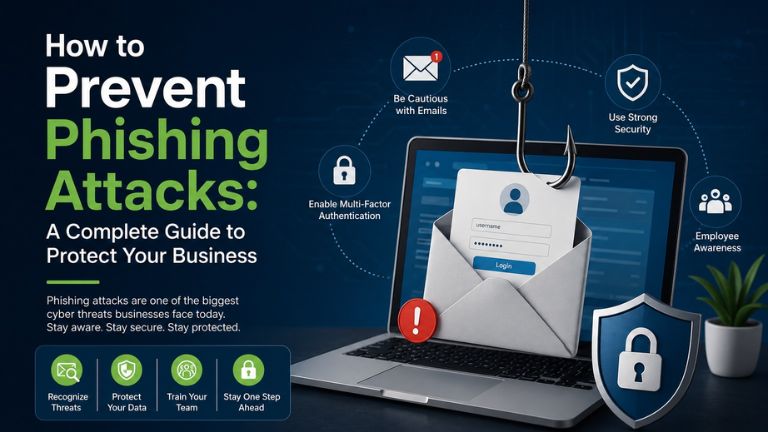
Currently, phishing attacks remain one of the most serious cybersecurity threats to companies. Criminals use deceptive emails, fake websites, text messages, and social engineering to fool employees into providing information such as passwords, banking details, and confidential information.
In fact, numerous cybersecurity reports confirm that phishing is cause for many data leaks and ransomware attacks. Just one click on a harmful link can lead to losses.
The good news is that phishing attacks can be prevented. With the right cybersecurity measures in place companies can seriously reduce the likelihood of phishing attacks.
What is a Phishing Attack?
A phishing attack happens when criminals pretend to be trusted organizations, peers, or service providers in order to trick people into:
- Providing them with their usernames and passwords
- Disclosing their financial information
- Downloading viruses
- Opening malicious files
- Clicking on illegal hyperlinks
Phishing emails often seem legitimate and may incorporate logos of companies, urgency, fake accounts, or verifications.
Common Types of Phishing Attacks
Email Phishing
It is a type of phishing where the attacker sends emails that appear to have been sent by a bank, or a cloud service provider, or internal employees.
- Spear Phishing
It is a targeted attack that focuses on a particular person in an organization.
- Whaling
It is a type of phishing that targets big shots like top executives and senior management.
- Smishing
Smishing is phishing through SMS or text message containing harmful links.
- Vishing
Vishing involves making phone calls where the scammer claims to represent a bank, IT support, or government agency.
- Clone Phishing
In this case, the scammer copies an original email and replaces the attachment or link with a harmful one.
Why Phishing Attacks Are Dangerous
Successful phishing attacks can result in:
- Financial fraud
- Identity theft
- Business email compromise (BEC)
- Data breaches
- Ransomware infections
- Loss of confidential customer information
- Regulatory penalties
- Reputation damage
Even organizations with advanced security tools remain vulnerable if employees are not trained to recognize phishing attempts.
How to Prevent Phishing Attacks
1. Train Employees Regularly
Employee awareness is the first line of defense against phishing. Conduct regular cybersecurity awareness sessions that teach staff how to:
- Identify suspicious emails
- Verify unknown senders
- Avoid clicking suspicious links
- Report phishing attempts immediately
Frequent training helps build a security-conscious workplace where employees can recognize and respond to evolving phishing techniques.
2. Enable Multi-Factor Authentication (MFA)
Multi-factor authentication adds an extra verification step beyond passwords. Even if attackers obtain login credentials through phishing, they cannot easily access accounts without the second authentication factor.
MFA significantly reduces the risk of unauthorized access to email, cloud applications, and business systems.
3. Use Cutting-Edge Email Security Technology
- Business email security solutions can effortlessly identify:
- Malicious hyperlinks
- Threatening file attachments
- Fake domains
- Fake impersonation
- Business Email Compromise incidents
Email filtering systems stop a lot of phishing scams from reaching the inboxes of employees.
4. Confirm Each Payment Request
- Finance departments should not authorize any payment based on emails alone.
- Use verification methods, for example:
- Phone confirmation
- Double approval process
- Executive verification
- Supplier verification
- Simple verification could save companies from losing big money.
5. Update Your Software Regularly
Cybercriminals tend to use outdated technologies.
- Keep your systems up to date:
- OS
- Web browsers
- Email applications
- Antivirus
- Firewalls
- Business tools
- Patching opens up the security.
6. Employ Endpoint Detection and Response (EDR)
The Endpoint Detection and Response (EDR) solution watches over all endpoints at all times.
EDR can:
- Detect malware
- Stop ransomware
- Detect credential theft
- Isolate compromised systems
- Conduct forensic investigation
This reduces losses in cases of successful phishing attempts.
7. Use DNS and Web Filtering
Phishing attacks often redirect users to fraudulent websites.
DNS filtering permits blocking of:
- Dangerous sites
- Phishing logins
- Sites known for phishing
- Malicious downloads
This prohibits employees from inadvertently accessing malicious sites.
8. Create Strong Password Policies
The usage of weak passwords enhances the impact of phishing attacks.
The best practices should be:
- Long passwords
- Using password managers
- Different passwords for each account
- Changing passwords regularly
- Passwordless authentication if feasible
9. Limit User Access
It is necessary to apply the Principle of Least Privilege.
People should only gain access to systems that are necessary for performing their job functions.
Thus, if one account is compromised, the attackers will not easily get into the main business systems.
Every organization should have a defined plan regarding phishing response.
Best Practices for Employees
- Avoid clicking on unknown links.
- Carefully check the email address of the sender.
- Report any suspicious emails as soon as possible.
- No sharing of passwords through email.
- Do not open links that are unexpected.
- Always confirm payment request with a second party.
- All devices should be locked if unattended.
- Use only company-approved software for any work-related activities.
- Activate MFA wherever applicable.
- Do not click without thinking.
Technologies That Help Prevent Phishing
Companies should invest in different levels of security:
- Email Security Gateway
- Security of Final Points (EDR)
- Security of Extensive Detection (XDR)
- DNS Protection
- Firewalls
- Virus Guard Software
- IAM
- 2FA
- Security Awareness Programs
- SIEM software
Layered security offers better protection than using only one security solution.
Phishing scams are growing more advanced as they use artificial intelligence-generated emails, deepfake voice technology, and more personalized social engineering techniques that make them appear more sophisticated with time. The days when businesses were able to merely depend on their antivirus software for protection are long gone.
Strong protection entails taking into account the importance of employee education level, using advanced email protection tools, utilizing multifactor authentication, and having endpoint protection in place, not to mention having clear security policies. Regular training, proactive monitoring, and multi-layered protection would significantly lower the chances of falling victim to phishing scams.
By investing in prevention in advance, organizations ensure their sensitive information protection.
FAQ
1. What is the most frequent type of phishing attacks?
Email phishing is the most frequent form of phishing where scammers impersonate reputable institutions to obtain confidential information.
2. Can phishing succeed against antivirus software?
Yes. Newer phishing attempts focus on manipulation rather than on malware, making employee training and email protection equally important.
3. Is Multi-Factor Authentication effective against phishing?
Yes. MFA provides another layer of authentication, which makes accessing an account extremely challenging even with a stolen password.
4. How frequently should businessmen conduct phishing awareness training?
Experts recommend that companies train their employees at a minimum of quarterly intervals, with periodic educational simulations.
5. Which kind of businesses are prone to phishing attacks?
Businesses of every size are vulnerable, although companies involved in financial transactions, consumer data management, healthcare data, and intellectual property are particularly appealing.
ALSO READ