
EDR vs XDR: Which One Should You Choose
As technology advances, so too do cyberattacks. Therefore, organizations require robust security systems to prepare for an impending threat and mitigate damage in the event of an attack. Unfortunately, traditional antivirus systems are insufficient when it comes to stopping attacks from individuals trying to steal data or perpetrating other cyber crimes.
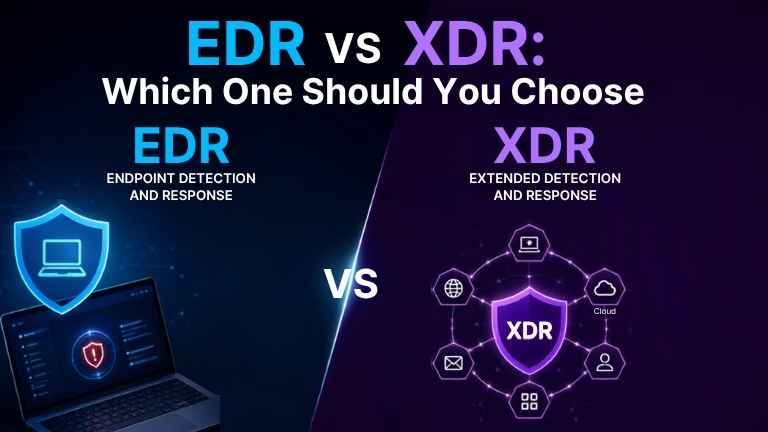
Endpoint Detection and Response (EDR) and Extended Detection and Response (XDR) are two prominent examples of technology being used to combat cybercrime. However, along with being useful, these two technologies actually differ from each other in terms of functions and threat understanding.
To learn the difference between EDR and XDR, check out the guide where you will read about what they are, how they differ from each other and which one would suit your organization better.
What is EDR?
Endpoint Detection and Response (EDR) is the kind of security technology whose role is to track, capture, analyze and deal with threats at the endpoint devices like:
- Laptops
- Desktops
- Servers
- Mobile devices
- Virtual machines
EDR helps to gather information on endpoint activities, spot any kind of suspicious activities, and allow security specialists to be involved in treating threats before they have a chance to grow into a bigger offense.
Key Features of EDR
- Ongoing endpoint monitoring
- Detection of threats in real time
- Behavior analysis
- Malware detection
- Incident investigation
- Automated response to threats
- Endpoint isolation
- Digital forensic capabilities
What is XDR?
XDR (Extended Detection and Response) constitutes a modern cybersecurity solution that expands security to areas beyond endpoints, as it provides clients with a unified platform encompassing different cyber defense layers.
Instead of simply tracking endpoints, XDR aggregates all security feeds from:
- Endpoints
- Email security
- Cloud-based applications
- Identity systems
- Firewalls
- Network channels
- Servers
- Security Information and Event Management (SIEM) technologies
as a result maximizing the visibility of the entire IT infrastructure of the company.
- Ultimate features of XDR
- Cross-platform threat identification
- Consolidated security dashboard
- Automation of investigation processes
- AI-driven analytics
- Integration of intelligence information
- Automation of security processes
- Correlation of incidents
- Institution of automatic response systems
EDR vs XDR: Key Differences
| Feature | EDR | XDR |
| Coverage | Endpoints only | Endpoints, network, email, cloud, identity, servers |
| Visibility | Endpoint-level | Organization-wide |
| Incident Response | Endpoint behavior | Automated multi-layer response |
| Investigation | Endpoint-focused | Full attack chain analysis |
| Complexity | Moderate | Advanced |
| Best For | Small and medium businesses | Large enterprises and growing organizations |
Benefits of EDR
Endpoint+ Endpoint Protection
The EDR protects endpoints and offers protection from malware, ransomware, and attacks made on endpoints.
Quick detection
By using behavior-based monitoring, companies can spot instantly abnormal behavior and thus minimize the time cybercriminals go undiscovered.
Easier to implement
Since EDR deals exclusively with endpoint devices, it is easier to implement as fewer integrations are required as opposed to XDR.
Cost-effective choice
EDR is usually less expensive, making it a perfect choice for companies with a budget restricted for cybersecurity purposes.
Comprehensive analysis
With the help of thorough attack logs and timelines, the teams of cybersecurity specialists can explore the incidents more efficiently.
Benefits of XDR
Complete visibility into security
Data from every area of your company can be available with XDR.
Improved Threat Detection
Through the integration of data from different sources, XDR can discover sophisticated attacks that cannot be detected by other standalone security systems.
No more alert fatigue
XDR, unlike single-point solutions, ensures less number of alerts processed because it combines events with relation resulting in more cases.
Simultaneous reaction
Your security department now has a possibility to respond to threats in a number of environments simultaneously and thus significantly shorten the reaction time.
More efficient security operations
XDR lets you manage security without filling in too complicated systems from the outside effectively.
When Should You Choose EDR?
Only when your organization meets the following criteria:
1. You require only endpoint protection.
2. You have a small IT setup.
3. Your budget is limited.
4. You don’t have many security professionals on the team.
5. You already successfully employ other security platforms.
Thus, EDR is enough for start-up organizations and small enterprises.
When Should You Choose XDR?
XDR is suited to organizations that:
- Make extensive use of cloud computing.
- Have employees who work remotely or use a hybrid approach.
- Want centralized management of cybersecurity solutions.
- Are experiencing more advanced cyber threats.
- Conduct business in regulated industries.
- Have multiple tools that need better integration.
XDR provides companies the advantage of lower risks, in terms of visibility, since it gives a company an affordable and easy-to-manage solution that allows the monitoring of the entire IT system of any organization.
The difference between EDR and XDR is that the right choice will depend on the size of the organization.
Choose EDR if you want the easiest way to protect endpoint devices cost-effectively.
Choose XDR for the same protection at a higher level, which helps you to have full visibility over the entire environment and act faster when dealing with more complicated multi-layer attacks.
Organizations that are successfully going through their digital transformation processes, leveraging cloud services, or supporting the work of remote employees, usually turn to XDR because of its potential.
Best Practices for Implementing EDR or XDR
The effectiveness of an organization's cybersecurity measures can be achieved by implementing the following strategies:
- Security policies must be updated periodically.
- Automated threat detection and response technologies are necessary.
- Endpoints must be continuously monitored.
- Employees must be trained with respect to phishing and cyber hygiene.
- Threat intelligence feeds must be integrated into the system.
- Regular vulnerability testing must be carried out.
- Backup and disaster recovery plans must be created.
- Security incidents must be analyzed regularly.
As can be seen from the above-mentioned points, organizations looking for the best security solution must choose between EDR and XDR. Businesses need a system that provides them with the necessary level of cybersecurity and protects them from advanced threats.
Conclusion
As cyberattacks continue to evolve, businesses need security solutions that go beyond traditional antivirus software. EDR provides robust endpoint protection and is ideal for organizations seeking focused, cost-effective security. XDR, on the other hand, offers broader visibility by integrating data from endpoints, networks, cloud platforms, and email systems, making it a powerful solution for detecting and responding to advanced threats.
The right choice depends on your organization's infrastructure, budget, and security objectives. If endpoint protection is your primary concern, EDR is a reliable option. If you require comprehensive threat detection and centralized security management across your entire IT environment, XDR is the smarter long-term investment.
FAQs
1. How does EDR compare to XDR?
While EDR focuses primarily on the monitoring and safeguarding of endpoint devices, XDR takes it one step further by providing protection across a wider range of channels including the endpoint, network, cloud, email, and identity systems.
2. Is XDR an upgrade from EDR?
The benefit of utilizing XDR over EDR comes from the fact that it brings together information from multiple security sources thereby allowing for more efficiency. However, for people of small private entities the simpler EDR may still work in their best interest.
3. Can XDR substitute EDR?
Indeed. In most cases, EDR is included as part of the XDR solution already hence providing endpoint protection apart from extended detection and response.
4. Which companies should choose EDR?
Startups and smaller organizations primarily interested in endpoint protection can opt for EDR due to its cost-effectiveness and straightforward nature.
5. Why is the application of XDR important in modern cybersecurity?
With the help of XDR organizations can easily identify advanced attacks, decrease alert fatigue, speed up their response time, and gain visibility into the overall cybersecurity framework.
ALSO READ
Power Your Business with Reliable Email Services
Power of Partnership Tech IT Cloud and Seqrite in Cybersecurity
Tech IT Cloud’s Journey as a Distributor of Seqrite
How Tech IT Cloud Delivers Enterprise-Grade Security with Seqrite